
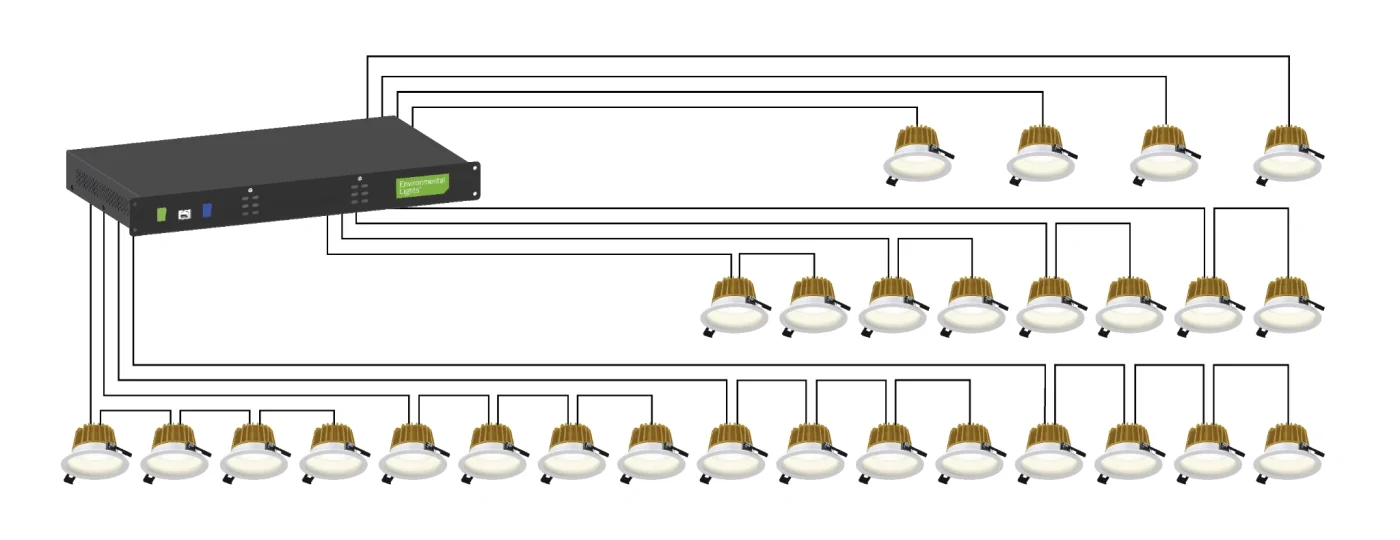
Low Voltage LED Downlights with Remote Power Supplies
With broader acceptance of digitally controlled lighting systems, low voltage LED downlights with remotely located drivers are becoming a more viable option for both residential and commercial lighting systems.
Common modern downlights use traditional wiring. Each light is fed by a switched line-voltage circuit from the electrical panel, and each downlight contains both the LED driver and the LED light source in one package.
Low voltage LED downlights split that package into two parts.
The first part is the part we see: the downlight itself. From the ground, it looks essentially the same as a common modern LED downlight.
The second part is the LED driver, which is remotely located somewhere accessible, such as a utility room, equipment room, or closet. Low voltage wire connects each LED downlight back to the remote driver, and a single driver can power multiple lights.
That relatively simple change creates major differences in both wiring and control.
As always, the intention here is to be informational, but please keep us in mind to design your system.
Wiring Differences
All-in-one (traditional) downlights that are controlled by the same switch are daisy-chained together. When the switch is turned off, the lights lose power and turn off.
Low voltage downlights are wired to the LED driver using 18-gauge low voltage wire, which is similar to common speaker wire but thinner. Lights with a static color temperature require one pair to be wired to the LED driver. Tunable white lights require two pairs to be wired to the LED driver.
An easy thing to do on a job would be to use 18/2 for lights with a static color temperature and 18/4 for lights with a tunable color temperature.
One LED driver can support anywhere from 4-48 lights depending on the configuration. The LED driver should be installed in a utility closet and is commonly located near either the electrical panel or the AV equipment cabinet.
Control Differences
Traditional downlights are controlled with light switches and dimmers, which simply regulate how much power is passed to the fixture, anywhere from 0-100%. That logic is no longer possible with low voltage LED downlights.
Each output channel on the LED driver is addressable. So if you had 24 can lights wired to one LED driver, they could inherit addresses 1-24.
The controls on the walls, in a mobile app, or in a home automation system tell the LED drivers which outputs to turn on and off. For example, the top button of a switch may be programmed to turn on/off downlights 1-6. Meanwhile, the home automation system can decide, “turn on only light number 3” for a nighttime scene.
In an addressable system, groups of lights are no longer bound together. Any light, or group of lights, can go on and off independently of one another. They can change brightness and color independently of one another as well.
These controls are much more powerful than traditional lighting controls. However, it must be known that with the increased capability comes increased difficulty in configuration. These lighting systems must be designed ahead of time with control in mind.
Most LED lighting drivers are controlled using DMX, which is a third-party standard that has great interoperability between devices and manufacturers.
Use Cases
Low voltage downlights will make sense in specific use cases.
Tunable White Lights
They are the ultimate solution for homes and buildings that use tunable white lights. In this situation, low voltage wiring is already being run to each light anyway, so that cable can just become an 18/4 instead of an 18/2, and then no line voltage needs to be run at all.
Tunable white lights do not natively work with traditional wall controls either, so the overhead in engineering a control solution becomes a non-issue, or at least an issue that solves the tunable white light control at the same time.
When Electrical Work Is Expensive
Many jurisdictions require that all electrical wiring be enclosed in metallic conduit, which can make the per-device cost of traditional downlighting very high. Retrofitting such conduit is even more difficult.
As the per-device cost of the installation gets higher, low voltage downlights make more and more sense. The low voltage wire itself, and the labor to install it, are less expensive.
This means that you will be reallocating money spent on installation into quality of light. This has a very high-impact effect on cost-benefit in new builds.
When Custom Is King
In the highest-end homes, dynamic lighting scenes make a huge difference. The addressability of each individual downlight channel allows the ability to create a wide variety of truly unique lighting scenes.
This is especially apparent for nighttime and soft-glow accent scenes because you can pick and choose individual LED downlights to be lit at different intensities and even different color temperatures.
How much does it cost?
It’s difficult to estimate how much small lots cost, but at scale we can start to identify an average.
A system with 100 LED downlights would cost approximately $31,000 or approximately $300 per downlight. This cost is only the cost of the lights. It does not factor any cost for controls, but it also does not consider any installation labor and material savings.
Most importantly, let’s consider what we’re getting for that amount.
- Dim-to-warm 1800k-3000k LED light engines
- Lighting quality of 95+ CRI
- A 3″ aperature recessed downlight profile
- Field swappable lenses for beam spread
The key is to compare the installed price per downlight against traditional downlights, then decide if the cost delta is worth it.
In markets where material and installation costs are high, the downlights become an increasingly better value.
For example, in Chicago, traditional downlight installation can cost $250-$300 per can light, while a low voltage downlight may only cost $150-200. At 100 downlights, that could be $10,000 shifted away from installation cost, and directly put towards quality of light.
Getting Started
We design, sell, and program these systems.
We can modify your existing lighting plan or build a new one from scratch. We ship the materials along with drawings and instructions for installation. When everything is installed, we program the system and provide enough revisions to make sure you love it.

