
At MyEasytek, we believe the best smart homes begin with a homeowner-led approach to home technology design. Your vision drives the process, and our expertise brings it to life.
As your home technology consultants, we work alongside you, your architect, and your builder to design and specify lighting, lighting controls, audio/video, and home automation systems tailored to your lifestyle, preferences, and budget.
Our extensive experience with technology, products, and real-world installations allows us to guide you through an increasingly complex landscape of options. We help you make informed decisions, avoid costly mistakes, and ensure every system is thoughtfully planned and seamlessly integrated.
Our goal is simple: to empower homeowners to make confident technology decisions and build homes that are smarter, more connected, and ready for the future.
A Collaborative, Big-Picture Approach to Technology Design
When construction isn’t imminent, we have the opportunity to take a more deliberate, homeowner-led approach to technology planning.
Rather than designing each system independently, we begin with a high-level overview of your home’s lighting, audio/video, and automation systems. Together, we explore different levels of functionality, the possibilities each system offers, and their associated costs. This establishes a realistic picture of what’s possible within your overall budget.
From there, we follow an iterative design process, gradually refining each system while keeping the entire home’s technology plan in perspective. As priorities become clearer, we adjust budget allocations, explore alternatives, and work toward the right balance of features, performance, and cost.
The advantage of this approach is that no single system is designed in isolation or allowed to consume the budget without considering the others. Every decision is made in the context of the complete project.
When construction is imminent or already underway, our approach shifts to accommodate the schedule.
We prioritize the design decisions that need to be made immediately, particularly those affecting electrical rough-in, wiring infrastructure, and other time-sensitive construction milestones. This allows us to provide the direction your builder and trades need to keep the project moving without prematurely committing to decisions that can be made later.
Once we’ve addressed the immediate construction requirements and established some breathing room in the schedule, we return to the broader design process. We can then take the time to refine each system, revisit priorities, and ensure the remaining decisions are made in the context of the entire home.
Whether we’re involved early in planning or brought in during construction, the goal remains the same: a cohesive, fully integrated technology plan that reflects your priorities, makes the most of your budget, and delivers the features that matter most to you.
Why Is This Approach Better?
Two Traditional Models. The Same Fundamental Problem.
Traditionally, homeowners have relied on two types of contractors for these projects: electricians and audio/video integrators. Both bring valuable expertise, but both operate within business models that have limitations.
Electrical contractors are experts at electrical installation, but they’re not always technology-forward.
A qualified electrician knows how to install wiring, devices, fixtures, and electrical infrastructure safely and efficiently. But when it comes to modern lighting controls, automation, and connected home technologies, their approach can sometimes be limited. The traditional electrical contracting model tends to reward completing the specified work efficiently and moving on to the next job, rather than exploring possibilities beyond the immediate scope.
The work may be completed correctly and to code, but that doesn’t necessarily mean the homeowner receives the best technology solution.
AV contractors often understand the technology better, but their business model creates a different challenge.
Good AV integrators often go well beyond the minimum requirements. They understand how systems interact, anticipate homeowner needs, and focus on the overall user experience.
The challenge is that traditional integrators rarely charge directly for their design expertise. Instead, they recover those costs through equipment markups and installation labor margins.
On smaller projects, healthy margins are essential to compensate the integrator for the time spent designing and managing the job. But as projects grow, those same percentage-based margins can generate returns that far exceed the additional design effort required.
Some projects fall comfortably within the economics of this model. Others don’t.
There’s nothing inherently wrong or dishonest about this business model, but there’s no clear mechanism to ensure that the price paid remains proportional to the expertise and effort provided.
Furthermore, the model can incentivize integrators to expand their scope of work, even when additional features or complexity may not make sense within the context of the overall project.
The problem isn’t the integrator. It’s a pricing structure that doesn’t consistently align compensation with the value of the work performed.
A Better Way to Structure the Project
Our solution is to separate design, equipment sales, and installation into three distinct buckets, each with its own responsibilities and transparent pricing.
The Design Bucket
The biggest difference between our approach and the traditional integrator model is how we charge for design.
We charge a fixed design fee based on the square footage of the home. This establishes the cost of our expertise upfront, making it predictable, transparent, and independent of the equipment we ultimately recommend.
Traditional integrators typically recover their design costs through equipment and installation margins. As a result, product selection and system design can become intertwined with the need to recover those expenses.
Our model separates these incentives. Because our design services are compensated directly, we can focus on developing the best solution without having to consider which products will generate enough margin to pay for our design efforts.
The Sales Bucket
Because our design services are priced separately, we can offer consistent equipment pricing with predefined discounts from MSRP, regardless of the size or complexity of the project.
But we also recognize that equipment margins can reasonably contribute toward the cost of design, just as they do in the traditional integrator model.
That’s why we offer a Design Credit Program.
As customers purchase equipment through us, a predetermined portion of those purchases is credited back against their original design fee. With enough purchases, the entire design fee can be recovered.
This preserves one of the benefits of traditional integration—having design costs covered through equipment sales—but replaces the uncertainty with a transparent, predictable formula.
Instead of hiding the cost of design in equipment margins, we establish that cost upfront and give customers a clear path to earning it back.
The Installation Bucket
Separating design and equipment sales from installation makes the final piece of the project much easier to price and evaluate.
With a completed design and clearly documented installation requirements, the homeowner or builder can issue the same Request for Proposal (RFP) to multiple contractors.
Instead of asking three contractors to propose three different solutions, we’re asking them to price the same work.
In the traditional model, three AV integrators might return three entirely different system designs at three very different price points. Comparing those proposals becomes difficult because you’re evaluating the equipment, design, and installation all at once.
Our approach removes those variables. Each contractor receives the same specifications, equipment list, and installation requirements, allowing their proposals to be compared on a much more equal footing.
One could argue that removing design and equipment sales from the installation contract might limit the pool of interested contractors, particularly those accustomed to relying on equipment margins to supplement their labor revenue. In some cases, that’s true.
But it also opens the door to a different group of contractors: skilled electricians and AV installation teams who are fully capable of executing a sophisticated system but don’t necessarily have the in-house expertise to design one.
With detailed plans and clear installation procedures, these contractors can compete for work that might otherwise be beyond the scope of their traditional offerings.
The result is a broader range of qualified installation partners, more comparable bids, and a clearer understanding of what the installation itself actually costs.
Most importantly, it allows us to select contractors based on how well they install systems, rather than how well they design or sell them.
Everyone can focus on what they do best, without requiring the best designer to also be the best installer—or the best installer to also be the best designer.
What We Deliver
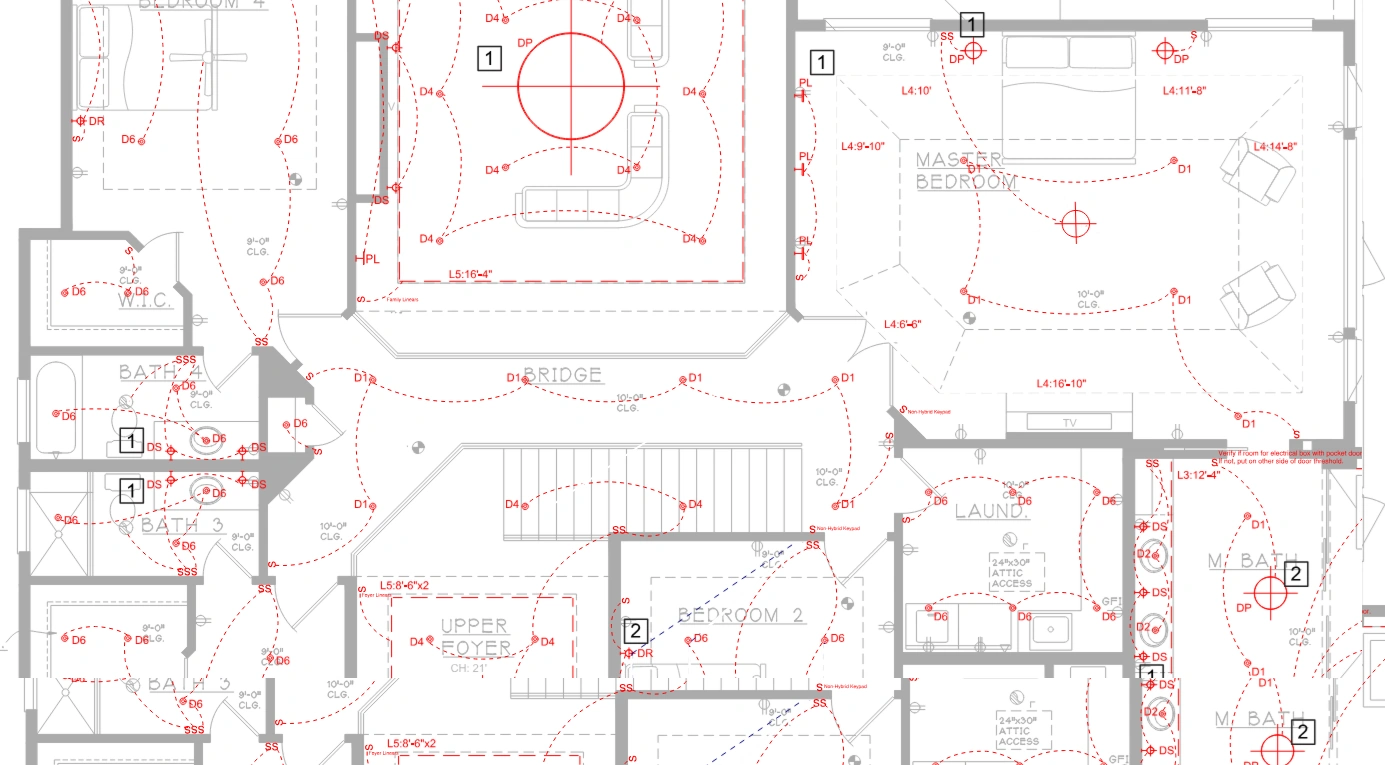
Much like an architect, our deliverable is an executable set of plans.
We don’t simply recommend products or provide a list of equipment to purchase. We develop a coordinated technology design that clearly defines what the finished systems are expected to do, how they will work together, and what is required to build them.
Our documentation translates the homeowner’s vision into a practical scope of work that qualified electricians and AV contractors can confidently price and execute.
This includes system specifications, equipment selections, device locations, wiring requirements, integration details, and installation instructions—all coordinated with the home’s architectural plans and construction schedule.
The goal is to remove as much guesswork as possible before installation begins.
Just as an architect’s plans allow multiple builders to bid on the same building, our technology plans allow multiple contractors to bid on the same installation.
And because the design is developed independently of the installation contract, it remains a valuable resource for the homeowner regardless of who performs the work.
Ultimately, our product isn’t just a technology design. It’s a documented plan for turning that design into a finished, functioning home.
Continued Support
Our responsibility doesn’t end when the plans are complete. We remain involved throughout the installation process to help ensure the finished systems perform as designed.
Our design fees include ongoing technical oversight and support during construction. We’re available to answer contractor questions, clarify specifications, resolve installation challenges, and make necessary design adjustments as the project progresses—all within the terms of the individual project agreement.
For our Lutron RadioRA 3 and HomeWorks systems, programming is also included within the scope of our original agreement framework. Our involvement extends beyond the drawings to configuring the lighting controls and delivering the intended functionality.
For audio/video and other technology systems, programming may be quoted separately depending on the project. Even when those services are outside the original design fee, we remain involved throughout the process, coordinating with installation contractors and providing the technical guidance needed to bring the project to completion.
Separating design from installation doesn’t mean separating design from responsibility. We’re there to support the people executing our plans and help ensure the homeowner receives the system we set out to create.
The Homeowner’s Advocate
Ultimately, we see our role as more than simply designing and supplying technology. We’re here to help homeowners make informed decisions and ensure the different parts of their project come together successfully.
That often means offering guidance beyond the systems we’re directly responsible for. Sometimes we can provide specific advice; other times, we help homeowners understand their options, ask the right questions, or find the right people to help.
We take this approach because we care about the overall outcome, not just our individual scope of work.
At the end of the day, our goal is simple: to help homeowners make good decisions, get the most out of their investment, and end up with a home that works the way they envisioned.

